Sunday, November 23, 2008

Tools of the Trade


I always smile when people ask if I have a bread machine when the topic of baking bread comes up. I normally don't advertise that I'm a weekend baker, but inevitability over some sort of meal the topic of baking will somehow rise to the surface (pun intended).

When I answer "no" to the bread machine question the predictable response is "oh, wow, so do you have a big mixer?" This is where the conversaton can go one of multiple directions. I DO have a mixer and I have used it to make dough in the past, but I don't use it now.

Most people have seen documentaries on TV where they see bakeries with huge stand mixers making hundreds of pounds of dough at once. They also have the experience of seeing the bread machines in the appliance isle of their local big-box outlet (Target, etc...)

99% of everyone out there has NO IDEA that bread baking can be so simple. To them bread is something they think very little about and the barriers to entry appear to be too high.

My tools:
* Large bowl
* Large Spoon to mix
* Measuring Cups (dry & wet)
* Ingredients (Flour, Water, Yeast, Salt)
* Saran-Wrap (or equivalent)
* Parchment Paper & Rice Flour [Optional]
* Non-terrycloth Towel
* Dutch Oven (cast-iron pot with a lid) [Optional]
* Oven capable of 450 degree heat for 2+ hours

The irony is that 90% of most homes have everything on this list already in their house. The only exception is usually yeast, which is an increasingly rare item for people to have.

Walking into a friend's home and baking bread with items they had on-hand is a great magic trick (if you aren't staying overnight I recommend my Focaccia Bread Recipe.

The whole point of this entire post is that baking bread kept humanity alive for thousands of years and is easier than you think it is.

-Matt the Weekend Baker

Sunday, November 9, 2008

Never too busy to Bake bread...


Things have been crazy busy at work recently. A good friend of mine (who is also a baker) commented that he hoped I would have time to bake bread this weekend (the last two weekends I've had to work).

My response was simple - I'm NEVER too busy to bake bread, but sometimes I just don't find time to post to my blog.

We talked for a bit about baguettes and the time & temperature techniques for them. I've been so enthralled with the dutch oven concept that I had almost forgotten all the tricks I learned for baguettes.

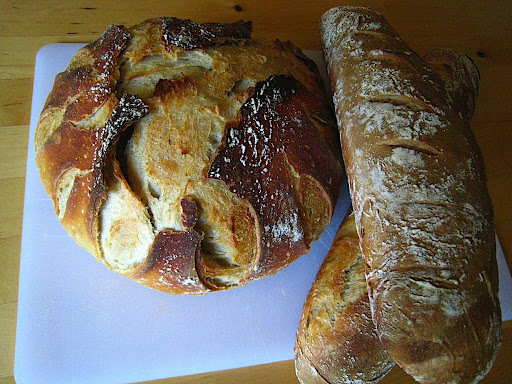
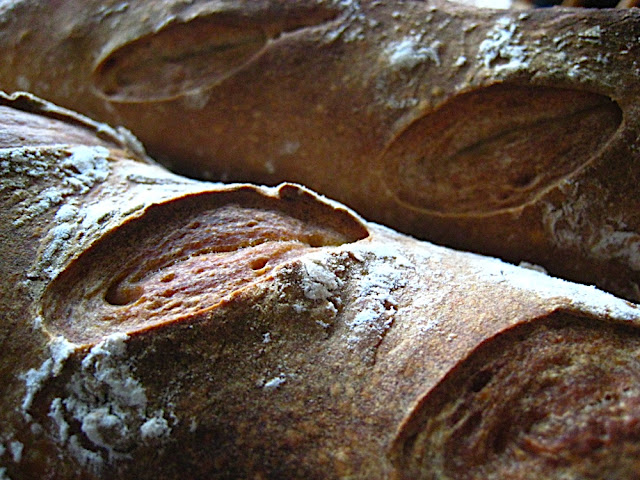
Basically the same recipie for sourdough (or regular dough) works. When you are shaping the loaf be sure to cut it in half and roll it into a baguette form, pressing a seam down the middle with your thumbs and then folding it over so the seam side is down. They bake at 450 for about 35 minutes, but in the first three minutes you must spray water into the oven every three minutes. This is where having a large hot iron pot in the oven is helpful because it instantly turns the water into steam. This helps develop the crust for the baguettes.

Give it a try yourself!
-Matt the weekend baker

Saturday, October 25, 2008

A new Sourdough starter feeding strategy


So I've been experimenting recently with a slight modification to my sourdough starter mixture. I've blogged about my sourdough starter several times before and if anything I think this is just another argument to the axiom that sometimes there is no right answer.

I noticed that my standard:
Save 1/4 cup starter, mix with 1 cup water & 1 cup AP flour
Seemed to be a bit 'soupy' which after rising for 8-16 hours seemed to be well mixed, but not quite as active as I am used to seeing.

My alteration is by trying:
Save 1/4 cup starter, mix with 3/4 cup water & 1 cup AP flour
This makes a thicker starter, more the consistency of play-doh. I've noticed that the ticker mixture rises better (easily doubling or sometimes tripling), plus it holds its shape more.

This thicker starter adds a richer more developed taste to my bread, which is always a welcome addition!


-Matt the weekend baker

Saturday, October 11, 2008

An update to a revolutionary recipe


The original Jim Lahey recipe for no-kneed bread published by Mark Bittman published in November 2006 (covered in this post) kicked off the revolution. Home bakers (like me) everywhere were inspired to give it a try.

Now Mark Bittman has revisited the technique and has talked with Jim Lahey about publishing an updated version of the recipe that started it all. Here is a link to the story:

No-Knead Bread: Not Making Itself Yet, but a Lot Quicker

Jim Lahey didn't approve of toying with the ratios and I think I agree.

The basic idea is that the more yeast you throw in, the shorter the rise-time. This is fairly basic "baking 101", but for the experienced baker the longer the rise the more developed the flavor of the loaf.

Of course there's always a trade-off when baking good bread vs baking quick bread. I've even blogged about this in the past. If you want a good quick bread then choose a recipe that's suited for it (and heavily flavored already). The whole point of fresh baked bread (french, sourdough or wheat) is to really TASTE the nutty flavor of the flower.

-Matt the weekend baker

Saturday, October 4, 2008

Four Basic Ingredients


At a dinner the other night a friend of mine lamented that I was stuck on baking. It does seem strange that a recipe with just FOUR basic ingredients could be so interesting and so challenging.

* Flour
* Water
* Yeast
* Salt

That's really all there is to it. Bread is about as simple as you can get, yet it's permutations are almost endless. Thinking it's simple is like comparing wine to grape juice.

Bread to me has a fascinating history (http://en.wikipedia.org/wiki/Bread) and has been baked by bakers for thousands of years. One of my favorite semi-historical reference is from the HBO mini-series "Rome" when one of the main characters (Titus) says "good bread this". I laughed at that moment because the bread the character was eating was essentially the same bread I was eating.

Four simple ingredients, two of which can be improvised (salt & yeast). Ten Billion combinations (ok a bit of a hyperbole there) and only a few hundred (or a few thousand) chances to try to get it right. Sounds fun to me!


-Matt the Weekend Baker


Side Note:
As proof that I am not stuck on bread, my culinary skills include (but are not limited to):
* Baked Eggs
* Omelets
* Crepes
* Eggs Benedict
* Sweet Rolls
* Dutch Babies (German Pancakes)
* Grilled Steaks
* Grilled Vegetables
* Grilled Salmon
* Cookies
* Gary's Salsa

Saturday, September 27, 2008

The value of bread


An interesting thought occurred to me the other day... how much is good bread worth? We buy sandwich bread for $3.99 at the grocery store, yet here is a rough breakdown of how much home-made bread costs:


IngredientMeasurePurchase WeightPurchase CostCost per GramPer Loaf Cost
Salt15737$1.00$0.0014 $0.02
Buckwheat Flour10907$3.28$0.0036 $0.04
All-Purpose Flour504536$5.79$0.0013 $0.06
White Whole Weat Flour502268$5.49$0.0024 $0.12
Bread Flour3402268$5.49$0.0024 $0.82
Water3253780$1.00$0.0003 $0.09
Sourdough Flour (AP)
504536$5.79$0.0013 $0.06
Sourdough Water503780$1.00$0.0003 $0.01


$1.23


So the costs of the ingredients is clearly less than the store-bought bread, but what about the actual baking? My Kennmore 96413 is rated at 10 - 13.5 kW. Running at 450 degrees I'm going to assume I'm using 13 kW of juice, though the insulation on this oven is incredibly efficient so I don't think it's pulling the full load for my entire bake cycle. Power in our area goes for 7 - 9 cents per kWh, so at the worst case scenario I'm probably using $0.18 of electricty, bringing the grand total up to $1.41.

I don't drink coffee, but I'm fairly sure that's less than your average cup of joe.

-Matt the weekend baker

Saturday, September 20, 2008

Sourdough Starter Troubles (Chlorine & Chloramine)


So to my great surprise the sourdough starter I have been faithfully using for over a year has recently gone 'flat'. I will feed it per my usual schedule and it does rise, but it doesn't "bounce" to it's normal doubling.

As any good baker will know, a starter will show vigorous activity within the first hour and should double within 4-8 hours depending on the ratio of starter to water/flour it was fed.

I had a real mystery on my hands so I decided to try and figure out what happened. After a few experiments I narrowed the suspects down to temperature & water. I was able to eliminate the temperature variable by trying a cultivation in a stable tempature area with no sunlight (to minimize variations), so that just left water. I had been using the same tap water for over a year, but obviously something changed.

Our tap water is moderately hard, but normally calcium does not affect sourdough starters. Though my hypothesis was that maybe our local water municipality changed the percentage of chlorine in the water.

I tested this theory out by cultivating a new starter from some preserved starter I had saved for an emergency (more on that in another post). I cultivated this new starter with only bottled water. It was a bit more expensive than tap water but after a week it seemed to be showing strong results.

To double-verify my results I did one feeding of the new starter with tap water, and it had disastrous results. It killed a good portion of the starter.

While I was pleased that my hypothesis was confirmed I was still baffled at why tap water would suddenly become so hostile. It turns out that the water municipality had changed from Chlorine to Chloramine (which is a derivative, and more stable).

A quick check on Google confirmed this: http://www.sourdoughhome.com/startingastarter.html

Sourdough by it's nature is a hardy bacteria that can survive all sorts of different environments, but when it encounters chemicals that are anti-bacterial in nature it makes it hard to grow the way it should.

It looks like it's time to start experimenting with dechlorination, or I'll just buy bottled water by the jug.

All this trouble hasn't stopped me from baking 2-3 loaves per weekend, even with a semi-flat stater. Nothing can come between a baker and his bread.

-Matt the weekend baker.