Showing posts with label Starter. Show all posts

Monday, May 16, 2011

Unimpressed

So far I'm unimpressed with the San Francisco sourdough starter I ordered from California. Initially it had little taste, but it did improve somewhat with age (as most sourdoughs do). I'll give it another week before passing full judgement.

Saturday, April 30, 2011

Starter - RIP

I've noticed that about every 12-18 months my starter will just quit on me. Sourdough starter is actually a unique symbiosis between two different types of bacteria. I've actually seen this coming for a while now and have been wanting to experiment with a more authentic San Fransisco sourdough.

The problem is that 95% of all San Fransisco sourdough starters out there are NOT from San Fransisco (or even California).

The last starter I got was from Texas, there were two more from different parts of Texas, one from Iowa, one from Idaho and one from Oregon. I finally found one that's from San Jose Califorina which is about as close as I could get with mail-order. It should arrive this week so I'll let you know how it turns out!

-Matt the weekend baker.

Monday, May 3, 2010

The Great Sourdough Starter Debate

So amongst artisan and hobby bakers (such as myself) there is a debate on if 'local flora' bacteria can influence sourdough starters imported from other areas of the world.

The Wall Street Journal (who I have not see cover baking issues very often) has a really good article to talk about both sides of the debate.

Here are two experts:
"In one camp are bakers, both amateurs and pros, who believe starters are unique elixirs that reflect the place where the starter was originally mixed. This theory holds that airborne microorganisms are largely responsible for a starter's flavor characteristics."

"This camp cites scientific papers that find the varieties of yeast and bacteria present in a starter are largely determined by the frequency of feedings with flour and water, the type of flour used and the temperature at which the starter is kept. Microorganisms from the air, this camp believes, influence flavor very little. So it's unimportant when or where a starter originated."

You can find the entire article here (but only for a short time):
http://online.wsj.com/article/SB20001424052702304628704575185842461583472.html

It's a good debate. I won't say which camp I am in, but I do look forward to trying out both theories...

-Matt the Weekend Baker

Saturday, October 25, 2008

A new Sourdough starter feeding strategy


So I've been experimenting recently with a slight modification to my sourdough starter mixture. I've blogged about my sourdough starter several times before and if anything I think this is just another argument to the axiom that sometimes there is no right answer.

I noticed that my standard:
Save 1/4 cup starter, mix with 1 cup water & 1 cup AP flour
Seemed to be a bit 'soupy' which after rising for 8-16 hours seemed to be well mixed, but not quite as active as I am used to seeing.

My alteration is by trying:
Save 1/4 cup starter, mix with 3/4 cup water & 1 cup AP flour
This makes a thicker starter, more the consistency of play-doh. I've noticed that the ticker mixture rises better (easily doubling or sometimes tripling), plus it holds its shape more.

This thicker starter adds a richer more developed taste to my bread, which is always a welcome addition!


-Matt the weekend baker

Saturday, September 20, 2008

Sourdough Starter Troubles (Chlorine & Chloramine)


So to my great surprise the sourdough starter I have been faithfully using for over a year has recently gone 'flat'. I will feed it per my usual schedule and it does rise, but it doesn't "bounce" to it's normal doubling.

As any good baker will know, a starter will show vigorous activity within the first hour and should double within 4-8 hours depending on the ratio of starter to water/flour it was fed.

I had a real mystery on my hands so I decided to try and figure out what happened. After a few experiments I narrowed the suspects down to temperature & water. I was able to eliminate the temperature variable by trying a cultivation in a stable tempature area with no sunlight (to minimize variations), so that just left water. I had been using the same tap water for over a year, but obviously something changed.

Our tap water is moderately hard, but normally calcium does not affect sourdough starters. Though my hypothesis was that maybe our local water municipality changed the percentage of chlorine in the water.

I tested this theory out by cultivating a new starter from some preserved starter I had saved for an emergency (more on that in another post). I cultivated this new starter with only bottled water. It was a bit more expensive than tap water but after a week it seemed to be showing strong results.

To double-verify my results I did one feeding of the new starter with tap water, and it had disastrous results. It killed a good portion of the starter.

While I was pleased that my hypothesis was confirmed I was still baffled at why tap water would suddenly become so hostile. It turns out that the water municipality had changed from Chlorine to Chloramine (which is a derivative, and more stable).

A quick check on Google confirmed this: http://www.sourdoughhome.com/startingastarter.html

Sourdough by it's nature is a hardy bacteria that can survive all sorts of different environments, but when it encounters chemicals that are anti-bacterial in nature it makes it hard to grow the way it should.

It looks like it's time to start experimenting with dechlorination, or I'll just buy bottled water by the jug.

All this trouble hasn't stopped me from baking 2-3 loaves per weekend, even with a semi-flat stater. Nothing can come between a baker and his bread.

-Matt the weekend baker.

Saturday, September 6, 2008

Sourdough Starters

A good friend asked me why my current sourdough isn't a patch on the first sourdough loaf I baked years ago. I explained it was because my original starter was a local wild variety, which did taste good but seemed to be lacking in its ability to double a loaf effectively.

Sourdough yeast isn't something you can just go down to your local supermarket and buy, it's something you have to grow and cultivate. That seems to scare most people away from giving it a try.

The internet has introduced a whole range of options for the hobbyist baker. If you simply Google "Sourdough Starter" you will see a wide range of options.

From the free Oregon Trail Sourdough

To the world traveling collection.

The King Arthur Flour variety.

I picked up mine from www.sourdoughbreads.com.


If you are adventurous and want to try your own here are a few sites to explore:
http://www.breadtopia.com/make-your-own-sourdough-starter/
http://www.thefreshloaf.com/node/233
A short video: http://www.youtube.com/watch?v=cusjbAtGzvg

Remember - once you have a sourdough starter you must feed it to keep it alive. You can hibernate it in your refrigerator, but you have to take it out a few days ahead of when you want to use it again.

-Matt the Weekend Baker

Saturday, August 16, 2008

Sourdough Starter Rising


Just a bit of fun today. This is what Sourdough Starter looks like while it's rising. There are many factors that go into cultivating a good sourdough starter, time, temperature, food, water...

As Mike Avery shows on his http://www.sourdoughhome.com/ blog:
Time & Temperature are interdependent.
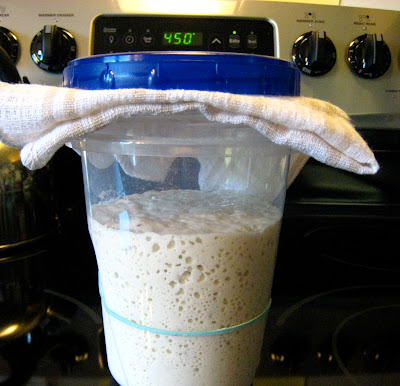


When I made the time-lapse video above my kitchen was approximately 75 degrees Fahrenheit (next time I'll display a thermometer). You can tell about 4.5 hours in (about 10am) the doubling had completed (the green rubber band is where it started).

I have such a long rise time (12-13 hours) because I can't come home from work in the middle of the day to refresh & feed the starter. So I compensate for the fast doubling time by increasing the ratio of flour & water to starter when feeding.

Most starter feed schedules call for doubling, I actually quadruple to keep the starter at it's fully doubled position for the 12-13 hours I use in my schedule. You can tell at the very end of the video that if I let it go for much longer (4 more hours) it would go 'flat' and eventually return to it's original level.

Go ahead, give it a try - it's not as hard as you think it is, my simple-to-follow instructions and schedule are in this post: http://matts-bread-log.blogspot.com/2008/08/weekly-sourdough-starter-schedule.html

-Matt the Weekend Baker

Saturday, July 19, 2008

Weekly Sourdough Starter Schedule


Timing is EVERYTHING with sourdough starters & bread. Here's my weekly schedule to produce some great loaves each weekend:

Wed 2100 - Take sourdough out of the refrigerator

Thur 0500 - Feed Sourdough (stir, save 1/4 cup, add 1 cup water, 1 cup AP flour, stir)
Thur 1900 - Feed Sourdough (13h) (save 1/4 cup, add 1 cup water, 1 cup AP)

Fri 0800 - Feed Sourdough (13h) (save 1/4 cup, add 1 cup water, 1 cup AP)
Fri 2100 - Mix dough & Feed Sourdough (13h) - 100g used per loaf

Sat 0940 - Turn on oven to 450 with Dutch-Oven
Sat 1000 - Flour & kneed dough and let rest, Store Sourdough in the refrigerator
Sat 1030 - Transfer dough to Dutch-Oven and score
Sat 1100 - Remove lid from Dutch-Oven
Sat 1115 - Remove loaf from Dutch-Oven and rest on a wire rack
(Let cool completely)
Sat 1400 - Eat! (save any left-overs in a ziplock freezer bag, should be good for 5 days).

Enjoy!
-Matt the Weekend Baker

Wednesday, June 27, 2007

Sourdough Starter


Baking bread is rewarding, but ultimately you will ask yourself "what can I do to really challenge myself?"

Ultimately the answer you will come to is - SOURDOUGH!

Bread books are filled with all sorts of starters, and some even describe how to cultivate your own local starter. I've done this, but nothing can beat the original Lactobacillus sanfranciscensis.

My friend DragonCoder sent me this link for Free, live pioneer-era sourdough starter and HangerMike pointed me to http://www.sourdoughbreads.com/.

I went ahead and spent $9 to purchase the authentic San Fransisco Sourdough starter I'm currently using. Sourdough is a live culture so it takes a bit of time to get used to it's feeding schedule.

For more information I highly recommend you check out the Sourdough entry on WikiPedia.

If you are in the local area I'll be happy to provide you some starter.

-Matt the Weekend Baker