Thursday, June 25, 2020

Flour types, bakers ratio, and experimentation... (and an update on timing)

Like most readers of this blog - I've been doing a lot of baking recently. I usually bake quite a bit, but with the global COVID-19 pandemic and associated shelter-in-place orders, I've had even more opportunities to bake and experiment.

Bakers Ratio - 72% 

Though because baking is so popular now, there are shortages of flour I usually use. I'm keen on using %90 King Arthur Bread Flour (450g) and 10% King Arthur While Whole Wheat Flour (50g) at 72% hydration (360g of liquid, which is usually about 320g filtered water + 40g starter) plus 10g of salt.
Note: It's essential to vary the amount of starter and keep the total liquid portion to be 360g to maintain a bakers ratio of 72%. If my starter is very active, I will sometimes go as low as 5g or as high as 50g depending on various environmental conditions and timing. 

Flour Types

While I had a large stockpile of KA Bread flour, it only lasted so long, and eventually, I had to find an available replacement. I settled on a 50lb bag of generic All-Purpose flour from Costco for $11.39.
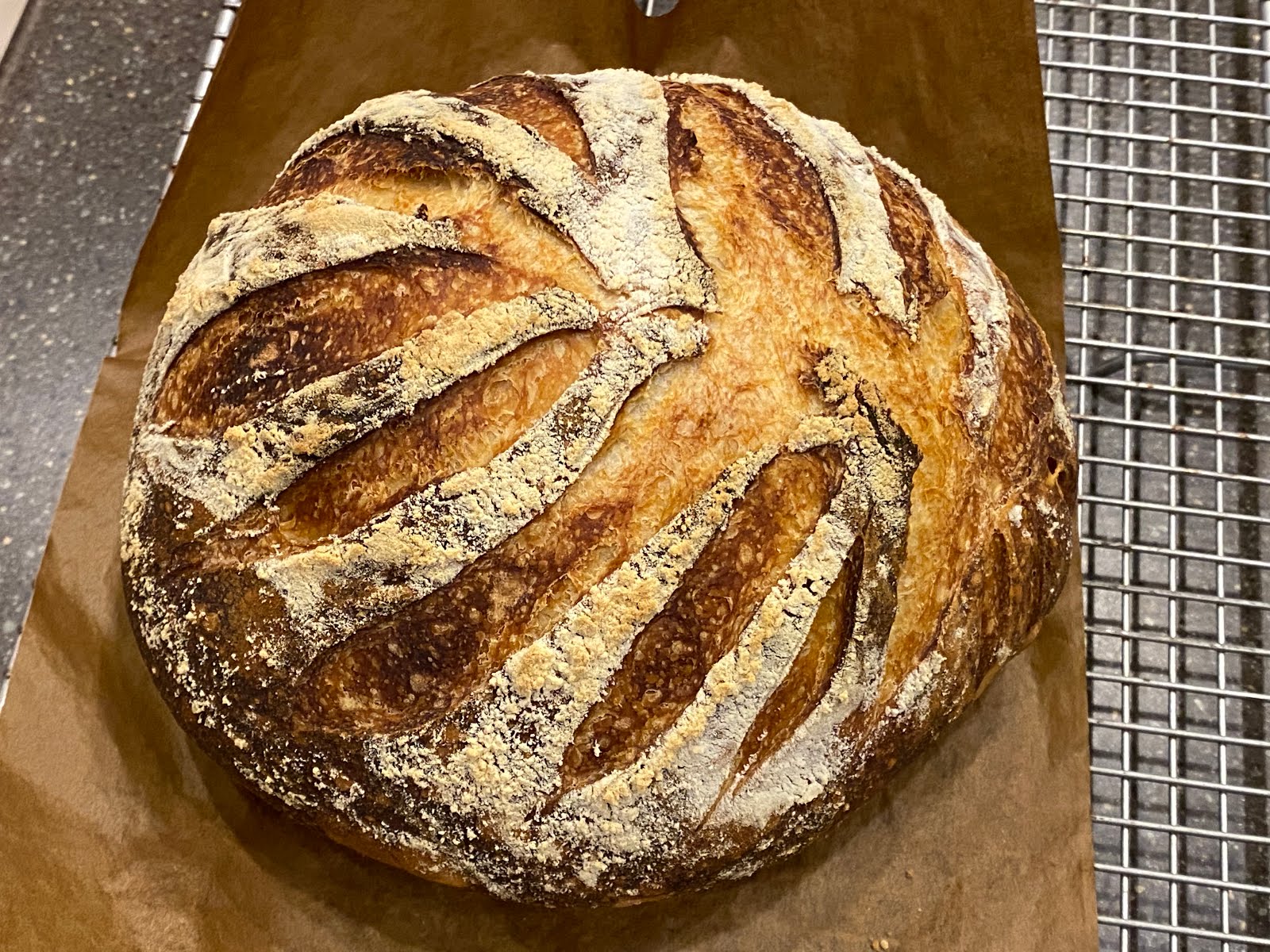
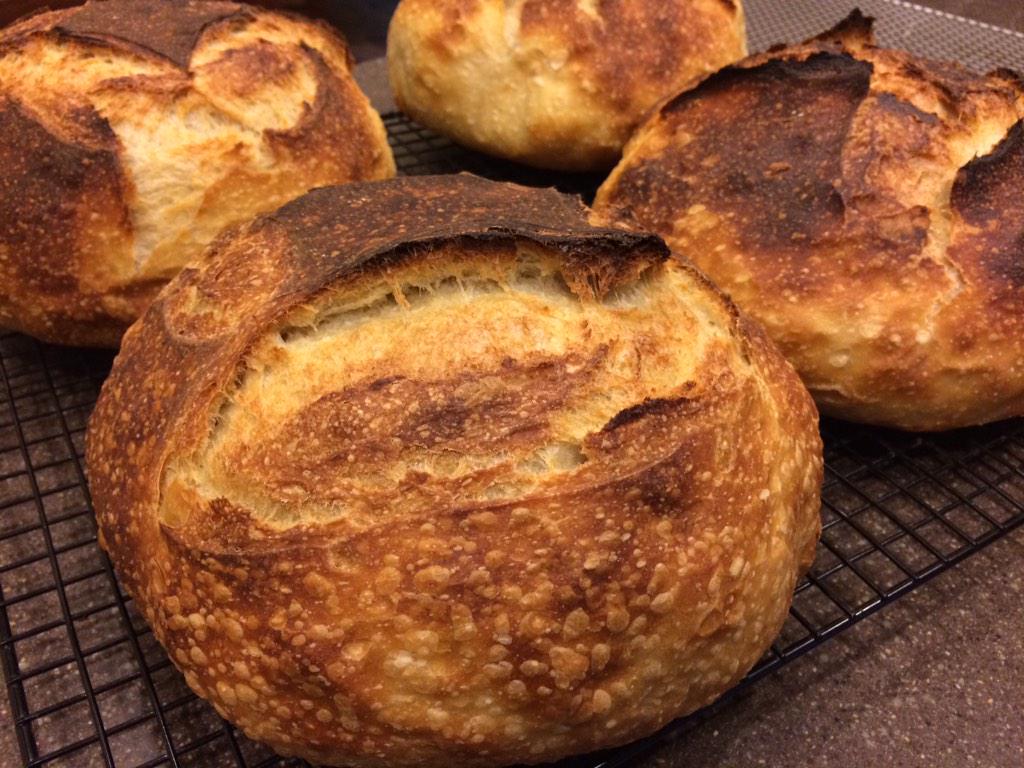
To most people, these loaves look and taste great, but they aren't up to my standards. 

Experimentation

While I usually don't like YouTube videos with numbers in the title ("top 10" or "10 tips", etc...) this video is a bit of an exception - he goes over a great way to experiment and visualize how to get the hydration right with the water and flour you are using. 

Timing

Update on timing - I usually follow this schedule:
Friday morning - taking the starter out of the refrigerator to wake up.

Friday evening - 7 pm - mix the water, flour, salt, starter into a dough, cover with plastic wrap, and set aside on the counter. I also refresh the starter and leave out overnight.

Friday night - 11 pm (4 hours later) - Wet my hands and punch-down & rotate the dough ball, and then re-cover with plastic wrap. 

Saturday morning - 8 am (9 hours later, 13h total)) 
  • Carefully transfer the proofed dough onto a floured surface, divide into the desired number of loaves (I usually do two) and gently shape. 
  • Note: My sourdough starter is very active, so adding only 40g (and sometimes less) means my dough is very airy and filled with CO2 filled gluten pockets.
  • Place the dough on parchment paper and place that in a cold dutch oven, cover with the lid, and set aside.
  • Turn on the oven to preheat at 500-550F.

Saturday morning - 8:30 am (~20 minutes after shaping, pretty much when the oven is done preheating) 
  • Remove the lid from the dutch oven, score the loaf with a lame, put the lid back on and place the dutch oven in the preheated oven.
  • If necessary, lower oven temperature to 500F.

Saturday morning - 9:12 am (42 minutes after placing in the oven) 
  • Carefully remove the very hot lid from the top of the dutch oven with oven gloves and get a feel for how browned the crust is.

Saturday morning - 9:22 am (10 minutes after removing the lid, about 52 total minutes of baking time)
  • Check that the crust is sufficiently browned and then carefully remove and place on a wire rack to cool.

Saturday morning - 11:30 am (about 2 hours after removing from the oven)
  • Cut & enjoy! 


Bake some bread! 😃
- Matt

Wednesday, April 1, 2020

Photos of baking bread are almost as good as the real thing...

After a good 25m proof - scoring with a lame:


After the first bake - about 42m:


After the second bake - about 15m (to give it some color):


Fresh out of the oven, on my favorite high-temperature parchment (which I can get several uses out of):


The obligatory crust & crumb 'money' shot:


Enjoy some bread!
-Matt

Monday, March 23, 2020

Now is a great time to make some bread!

"All of my friends are very aware of how much I love baking bread. Recently with the COVID-19 pandemic that is keeping a lot of people at home, many have reached out to me asking for tips of where to start. 

Here are two of my favorite videos from YouTube that should inspire anyone:
The recipe is available online, basically:

  • 450g strong (bread) flour
  • 7g salt
  • 290ml water
  • 5g fresh yeast (or generous pinch dried yeast)

This is from Alex which is a great YouTuber, who actually published a 4-part series on his "Sourdough Bread Odyssey"

Enjoy some bread 🥖 😀
-Matt

Thursday, October 3, 2019

Great bread article

I highly recommend reading this article by Claire Saffitz.

Saturday, February 9, 2019

Four more years of baking...


It's been a busy four years

Though I've still enjoyed baking (almost) every Saturday.

I've been working on perfecting my techniques

Finding new equipment

And experimenting with new results!

But most of all I've enjoyed teaching my daughters

Who are showing great promise!


Sunday, February 1, 2015

Announcement

Hello blog followers!  You may have noticed that my updates have slowed down in the recent months... this is a natural outcome of it being incredibly hard to post to Blogger quickly on my phone since the amazing Posterous was shut down.

For now I am shifting my weekly bread photo posts to Twitter and Google+ and when I have great things to say about bread recipes I will post it here.


Enjoy some bread :)
-Matt

Tuesday, August 19, 2014

Patterns

Sometimes I use paper towels to proof the final loaves. Here is the result. 


Enjoy some bread :)
- Matt

Tuesday, July 22, 2014

Tartine Bakery

Here is another good reference to the Tartine Bakery and Chad Robertson's recipie I've been experimenting with recently. 


Enjoy your week and try baking some bread :)

   -Matt

Monday, July 14, 2014

Variables

At a family gathering this weekend I was happy to discover that a cousin-in-law of mine also likes to bake. It was great to get caught-up with him and to trade tips and techniques for the art. 

One of the items that I mentioned was that there are quite a few non-recipe variables in-play with bread making that you have to keep in-mind:

1) kitchen temperature 
2) water temperature 
3) rise times
4) "liveliness" of the yeast (though this one is hard to measure) or amount of yeast (easier to quantify)

I recommended to him that if you keep the tempatures and times roughtly the same each week the one variable that is key to isolate and experiment is the liveliness of the yeast. It's isually best to adjust the amounts of starter you use each week and then subjectively score how the loaves turn out. 


Enjoy some bread!

    -Matt

Saturday, July 5, 2014

Adjusting

I'm still trying to "dial-in" the exact amount of starter to add for my standard 12-14 hour slow-rise. 


I'm still happy to eat the experiment each week :)

Enjoy some bread,
   -Matt

Saturday, June 21, 2014

Time and Tempature

Sometimes you have to burn a little bread to calibrate a new recipe and an unproven oven. 

This shows the importance of laying down a good layer of rice flour or cornmeal along the bottom of the Dutch oven. 

Thankfully I did have one really good success :)

Enjoy some bread!
   - Matt

Sunday, June 15, 2014

Better Bread

Last weeks loaf was a bit of an eye soar, this week I'm experimenting with the techniques that Chad Robertson talks about in his book "Tartine Bread" (see last weeks post for a link). 

I baked two loaves, one using his recipe (on the left) and one using mine (on the right) but both using his "turn frequently" technique. 

Overall I'm impressed with the technique and I look forward to exploring it further. 

Cheers,
    -Matt


FYI - my helper :)


Saturday, June 7, 2014

Baking Once Again

We are in the process of moving so this is the first loaf I've done in weeks.  Not the prettiest, but I certainly like the energetic rise of the local sourdough flora. 

One of my best friends has turned me onto a fascinating on bread baking. I've probably seen at least 100 books on bread and very few of them have impressed me, but this one has proven to be different. I highly encourage you get a copy and take a look for yourself.  I'll have more to say about it in the future.


by Chad Robertson

Take care and enjoy some bread!
  -Matt

Sunday, April 27, 2014

Last loaves in Virginia

We are packing up to move down to Texas, so these are the last loaves I'll bake in Virginia. 

It might be a few weekends before I get back into the swing of things. 


For now - enjoy some bread :)

-Matt

Saturday, April 19, 2014

Welcome Spring

Springtime is a great time to remember that bread rise times are heavily affected by ambient temperatures. 

Enjoy some bread :)
     -Matt


Sunday, April 6, 2014

Cultivating the best Yeast

I'm still experimenting with mixing different local floras of yeasts. 
I haven't found the perfect combination yet, but I will eventually.  

Enjoy some bread. 
   -Matt


Sunday, March 30, 2014

Weigh vs Meausre

So if you read this bread log (blog, get it?) with any regularity you will know I am a proponent of weighing all ingredients.  This is in the style of commercial recipes which call for exact weights which is contrary to most home recipes which call for exact measures.  The difference between the weight of flour and a measure of flower can be dramatic based on how dense (how aerated) it is.  

The only PROBLEM with weighing ingredients is when your scale runs out of batteries in the middle of a key weighing.  This happens to me occasionally because I use my scale a lot and it runs on small watch batteries that don't last as long as I would like.

When this does happen you have to go with your instincts and add as much flour, yeast, water or salt as you think is correct. This is where being familiar with the texture of your mixed dough comes in useful because you will know if its too wet or too dry.


Now it may be a bit of an optical illusion based on spacing of the loaves, but the loaf in the front of this picture is 50% larger than the loaf behind it... It just so happens that I added about 150 additional grams  of water to it, which means I needed to add about 160 additional grams of flour, overall it came out tasting fine but it was a fun experiment in ratios.

Speaking of ratios I highly recommend this book: Ratio: The Simple Codes Behind the Craft of Everyday Cooking.  It highlights the different ratios of flower, water, fat and sugar and how they range in spectrum from bread to cookies to cakes to pancakes and almost everything in-between.

Happy weekend, enjoy some bread!
   -Matt


Monday, March 24, 2014

Weekend Bread

No major updates this week.  Enjoy some bread!

Thursday, March 13, 2014

Cooling Bread


This is one of my favorite things about baking - the sound of loaves cooling right after they've been pulled from a 500+ degree oven.  It reminds me of the sounds of a campfire.

Normally I bake Saturday morning's and my two girls are in full "play" mode so I don't get any chance to record the subtle sounds, but this past weekend I baked later while they were napping.

Its just shy of 30 seconds and the focus is a bit off, but you can almost see cracks forming and you can certainly hear the thermodynamic activity.

Enjoy!
    -Matt


Tuesday, March 4, 2014

Good rise and finding the right wild sourdough yeast


Over the past few years I've experimented with cultivating several local "wild" yeasts.  I do this because every San Francisco starter I get usually gets taken-over by local yeasts within a few months.

Recently I have two distinctly different local yeasts I have been working with and what is fascinating is to see how they each have different qualities.

Yeast #1 (above) has a great rise.  The yeast reacts well to its environment and is able to produce an amazing amount of carbon dioxide (CO) that is captured in the gluten structure and causes wonderful bubbles in the crumb of the bread.  Unfortunately just like commercial yeast which you can buy in the supermarket (sometimes called "instant" yeast) this variety has very little taste.  The bread tastes ok (it is home made) but it does not taste distinctly sour.

Yeast #2 (from last week) has a reasonable rise but there are no large bubbles when cutting into the bread.  Thankfully what it lacks in rise it makes up for in taste.  The sourdough taste is amazing and really makes a distinct impression on whoever is lucky enough to be eating it.

So what do I do next?  Well I'm going to try bread made with BOTH yeasts to see if I can get the best of both worlds...  I'll post my results here.

Enjoy some bread,
     -Matt